Gledopto GL-C-619WL Elite 6D-EXMU
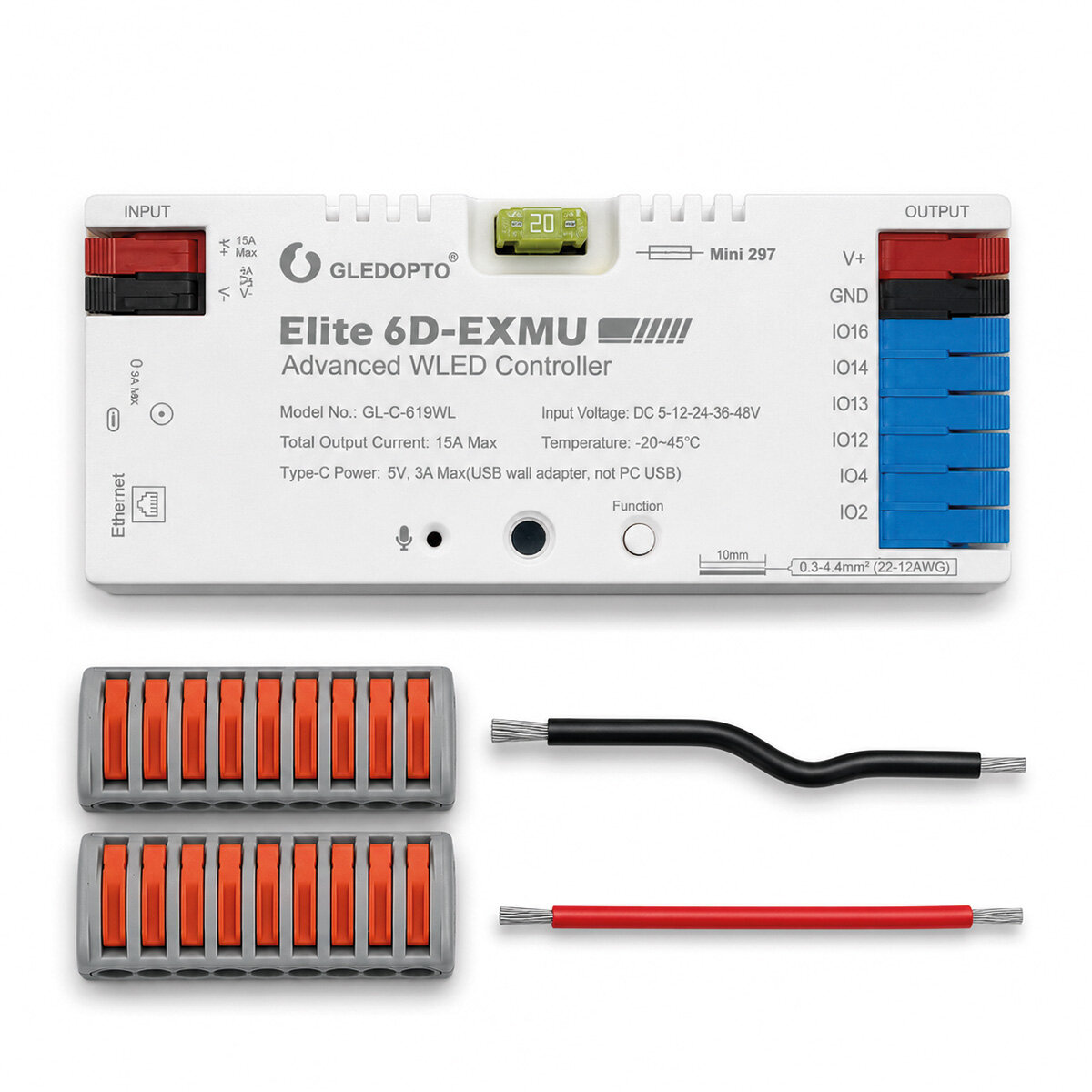
Gledopto's GL-C-619WL Elite 6D-EXMU is a WLED controller with six independent data outputs. It ships pre-flashed, in an enclosure, and with a network connection, microphone, and relay output on board. The price is 39.99 euros including VAT.
Thinking about the GL-C-619WL Elite 6D-EXMU?
Six outputs, one ESP32
At its core is an ESP32. The six data channels can be configured individually, which makes the controller interesting for setups where several strips need to be driven separately: ceiling perimeters with multiple segments, shelves, staircases, or matrix builds. Gledopto recommends it for up to 1,600 LED ICs.
The maximum total current is 15 A, protected by a factory-installed 20 A fuse. The controller is flexible when it comes to input voltage: 5, 12, 24, 36, or 48 V DC are all possible. For configuration alone, without any strips connected, there is also a USB-C input rated at 5 V and a maximum of 3 A.
Supported LED chips
Gledopto lists WS2811, WS2811F, WS2812B, WS2814A, WS2815, SK6812, SM16703, SM16703SP3, FL19038, FW1035, and UCS2903B. That, however, is only the list the manufacturer has tested itself or is willing to vouch for. What actually works is decided by the firmware, and WLED can do more.
Among the single-wire types, meaning all those that need just one data line, WLED supports WS2812B, WS2813, and WS2815, SK6812 with an additional white channel, WS2811 in both the 5 V and 12 V variants, GS8208, TM1814, TM1829, UCS8903 and UCS8904, and LPD6803, among others. On top of that come the types with two separate white channels: WS2805 for 12 and 24 V and FW1906 for 24 V, both RGBCCT. WS2814 also works, but has to be configured as SK6812 in WLED because it speaks that protocol.
All of these chips are an electrical fit for the six outputs of the 619WL, because they only need data and ground. So if you want to run a WS2805 strip with warm and cool white, you don't have to rely on Gledopto listing it on the product page; the option is available in WLED's LED configuration.
The second family is the clocked types: APA102, SK9822, WS2801, LPD8806, and P9813. In addition to the data line, they need a separate clock line. That works on the 619WL too, because behind the six outputs sit the ESP32's GPIOs, and those can just as easily be assigned as a clock pin in WLED. You use two outputs per strip for this, so six channels become three.
Network and control
Initial setup over WiFi works the usual WLED way via the WLED-AP hotspot, after which control happens through a browser or app.
A PDM microphone is built in, so WLED's sound-reactive effects work without an additional module. There is also a configurable relay output, which can be used, for example, to switch off a power supply when the LEDs are off. A function button on the enclosure turns the device on and off, changes the color, and resets it to factory settings.
Ethernet
In addition to WiFi, the 619WL has an Ethernet connection, and it comes preconfigured from the factory. If you connect the controller to the router by cable, you can skip the WiFi setup and reach the device directly through the app or browser.
If the setting is ever missing or gets lost after a reset, you'll find it in the WLED interface under Config, WiFi Setup, right at the bottom under "Ethernet Type". There you select "Gledopto Series with Ethernet", then Save & Connect. This selection is necessary because WLED needs to know the GPIO assignment of the respective Ethernet module; a generic entry won't work.
The practical benefit lies in two places. First, placement: a controller behind the TV, in the server rack, or in the garage no longer depends on WiFi signal strength. Second, data rate. If you feed effects via E1.31, Art-Net, or DDP from a computer or from xLights, at 1,600 ICs and 40 fps you're transmitting many times more than WiFi can reliably sustain in everyday use. Over cable, the stutters and dropouts that are hard to get under control on WiFi depending on the environment simply disappear.
Gledopto provides no information on Power over Ethernet, so the controller continues to be powered via the terminals or USB-C.
The WLED software
The firmware is already installed, so the controller runs straight out of the box. WLED is an open-source project under the EUPL-1.2 and the most widely used software for addressable LEDs on an ESP base.
Operation is through a web server that runs on the ESP32 itself. You open the IP address in a browser and have color selection, brightness, effects, and palettes in front of you. There are apps for Android and iOS that show essentially the same interface.
Included are over a hundred effects from the WS2812FX library, plus the noise effects and color palettes from FastLED. Using the segment function, a strip can be divided into sections that each get their own effects and colors. On the 619WL with its six outputs, this is the real lever: each output gets its own range in the LED configuration, after which you continue working with segments in the interface.
Settings can be saved as presets, up to 250 of them, and played back one after another in playlists. Presets can also trigger API calls, allowing you to build simple automations without an external system.
For integration with other systems, WLED brings quite a bit: Home Assistant detects WLED devices natively, and there's also MQTT, Alexa voice control including dimming and color changes, and synchronization with Philips Hue. On the stage and video side, WLED understands E1.31, Art-Net, DDP, and TPM2.net and works with Hyperion. Control via JSON and HTTP API as well as via infrared remote is also possible. Updates run over the air, and the interface can be protected with a password.
Enclosure
The enclosure measures 129 x 50 x 23 mm at 110 g and is made of flame-retardant PC in white. Protection rating IP20, so for indoor use only, without splash water. The permissible operating temperature range runs from -20 to 45 °C.
What's not included
The package contains only the controller. A power supply and cables have to be sourced separately, which, at 15 A total current and voltages up to 48 V, depends on the specific installation anyway.
Ready to pick up the 6D-EXMU?